The artist in residence scheme has always been a key aspect of the Whitworth Young Contemporaries programme. Each year we employ young, emerging artists under the age of 24, to deliver workshops with young people and deliver projects within the gallery.
This programme develops the artists skills as social practitioners and to give them the next step on the career ladder. The peer-led approach often means there is a collaborative, symbiotic nature to the relationship between the artist and young people and the young people are inspired by someone who is not too much older than themselves.
In lockdown 3.0 we recruited 3 very different artists to work with us. This included Helen Farley who explored augmented reality and coding; Polly from Westweaves, an artist an designer who led us through brand identity and how best to use social media to develop your practice; and finally Josie Tothill, a social practitioner who’s issue based sessions examined our place in history and the role of art and statues in the world around us.
We invited each artist to write a blog post to share their experiences of being artist in residence with us. Here, emerging artist and workshop facilitator Josie Tothill tells us about her experiences.
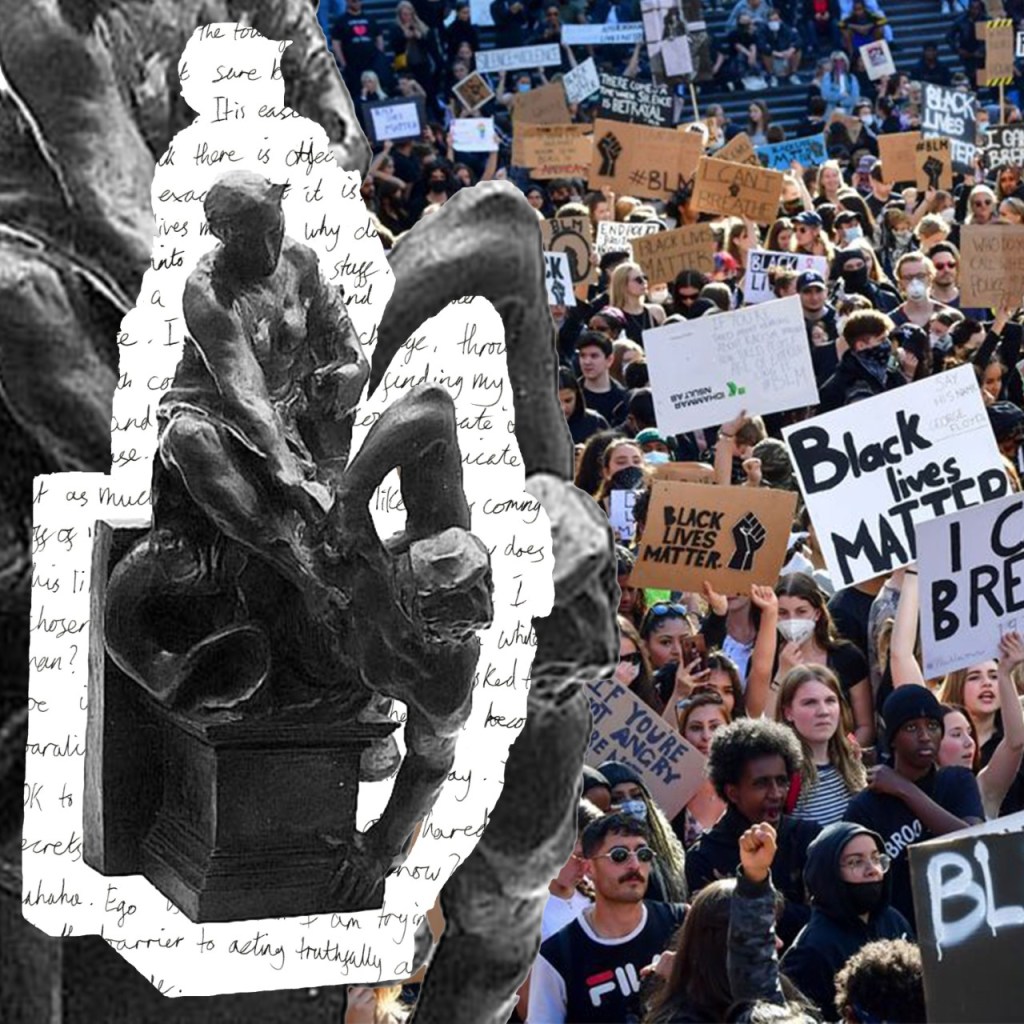
I used playful activities to explore other moments of upheaval and change. I led drawing activities looking at Hew Locke’s statues that depict colonial history and resistance and used that as a starting point for a discussion about statues and BLM, followed by a free writing activity during which many deeply personal feelings came up for a lot of us. I drew on my own practice of using the aesthetics of ruin to call into being a better future and asked the Young Contemporaries to ruin what they made in the session. The creative response was amazing! I saw work chewed up and made into new paper, ripped and inverted, scratched out and worn down. They said it felt liberating to mark this moment in time and to understand it as being in constant change.
In another session I explored artworks that tell stories at the intersection of place, time and emotion, focusing on a piece by Raiser Kabir about the partition of India. and asked the young contemporaries to tell their own stories through the objects they had to hand. Many stories were about loss and missing people, many were about connection and growth. We talked about what our objects represented that we wanted to change and choreographed movements to enact that change with the objects.
Many people said they found the activities meditative or therapeutic, I felt something similar myself. The opportunity to connect with others and give space to process the events of the previous year was very special to me. I think it is important that this process also had a political element to it, the idea that the world does need to change. I am very grateful to all the participants who made these sessions what they were and to The Whitworth for having me!
This time is especially difficult for young people who are feeling the effects of isolation, political upheaval and lack of security. Young people also hold the solution to these problems, the climate strikes, BLM movement and Kill the Bill protests are largely youth led and only becoming more radical. This is why youth leadership and amplifying the voices of young people is especially important right now. It’s been really special to hold space with other young people to explore our emotions and ideas and the more I connect with and listen to people, the more I believe the youth will lead the revolution.
 Gathering of Strangers