
Minecraft is the biggest, most popular gaming platform on the planet. It has hooked an entire generation of children with its addictive, open world gameplay, charming and warm retro graphics and cunning in-game crafting mechanics.
Coinciding with the Whitworth’s major capital development project in 2015, Whitworth Minecraft was a specially commissioned to showcase and compliment the new renovation into Whitworth park. The game aims to provide a balance between building and adventuring. Bringing the park and building together in inspiring ways with capabilities of collecting materials that can be used to express digital designs and builds.
The resource also draws on disciplines linked to maths, science, computing and art, providing an immersive, digital and creative way to shape, create and manipulate the gallery spaces and surrounding environments.
The target audience for this resource is children aged between 10 and 14 although since the launch of the Whitworth Minecraft, audiences of all ages have expressed an interest to play the game.
The complexity and depth of the game appeals to audiences of all ages. It has a crafting system that enables users to harvest and collect resources that mimic ‘real world’ material properties e.g furnaces that smelt sand into glass, that can be used to produce tools and structural building elements to make sculptures and curate spaces to tell personalised stories linking to the Whitworth’s collection.
It has also provided a solid way to simply communicate the process of textile dyeing. Using the in-game mechanics, we can link the process of dye and textile production to learn about materials.
Working alongside digital artist, Ross Dalziel, the resource was highly ambitious due to the chosen platform for the project. Minecraft is very popular on PC, but is emerging fast on the pocket edition on tools such as smartphones and iPads. The decision to build on iPads suited a more mobile, accessible device that can be managed more effectively in a gallery environment.
Challenges
The chosen platform provided a few challenges. Whilst the general, touch screen nature of the iPad is seen to be user friendly and responsive, having to construct and map out a build (on a one metre, one block scale) on the iPad proved to be time consuming and unreliable. It took a small team to work over the course of a few months to figure out coding with a ‘plug in’ that allows you to use a custom command that builds a large cube in front of you. After this breakthrough, the team were able to build cubed shapes and place them together to make the full Whitworth gallery. After this ‘plug in’, the team were able to finish the project within a week.
Gathering the information required to map out the build took effort due to the unique way the gallery is shaped (a complex, multi-floored design). Staff took trips to research floor plans, investigate gallery rooftops and the land in which the gallery is set on has a very distinctive flow that grants us a lower ground floor towards the west side of the building. Navigating and placing the individual rooms in the right spots was a delicate, step by step process but was integral to get the perspective right in order to provide a familiar feeling to the spaces for users who have visited the gallery previously.
We believe that we are the first organisation to build a replica of our gallery in pocket edition Minecraft. The server is available for anybody with the game to log in and play. The server that it sits on resets every midnight to protect the build and maintain a blank canvas for anybody wishing to explore the resource both on site and off.
Whitworth Minecraft will continue to morph and change over the next couple of years across various learning and engagement programmes. Conversations have taken place with local teachers (after a Minecraft CPD held at the gallery) who wish to use the server to build their own schools and link it geographically to the Whitworth.
The engagement tool is very reactive and easy to link to many topics and like the game itself; the possibilities for the future are endless.
Social Media Campaign
We launched Whitworth Minecraft in January 2016 at a professional development workshop for teachers. We explored the many ways it can support classroom activities linking to many subjects across the curriculum. Due to the CPD link going on Twitter, we had people from other industries join us such as consultants, system engineers and directors (NTTX Advisory) from Digital Rail.
In the aftermath of the CPD, The University of Manchester picked up the screen shot we used of the gallery façade, built in Minecraft, which received over 500 likes in two days.
On the cusp of the Masterclass month we started a series of online promotions on Twitter by recreating the ‘We’ve Been Building Something’ campaign leading up to the first anniversary of the gallery’s reopening.
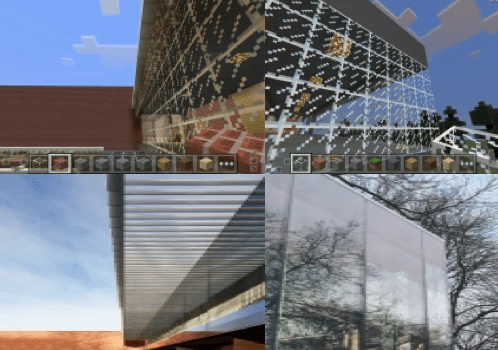
A promotional video was released on the University’s Facebook profile and received 5000 views over the weekend.
We gained confidence that we can embrace new technologies to help animate the gallery’s collection and that the game can compliment our exhibition spaces and enable users to develop a richer understanding of the stories we tell.
Minecraft Video
Masterclass
In March 2016 the resource was used for Minecraft Masterclass, where primary school children discovered the full learning potential of the game through a week of activities. Led by digital artists and animators, the workshop programme enabled pupils to learn coding, film and record commentary. A weekend Minecraft finale aimed at family audiences, sold out within 2 hours of being advertised on eventbrite.
Whitworth Minecraft off-site
We are working with and exploring how the virtual Whitworth in Minecraft can possibly enable people with autism to become more familiar with our surroundings pre-visit. We also wish to explore the idea that we can use this to increase literacy levels by introducing curatorial processes into the game – grouping objects to help tell stories ad new narratives. The pilot project was a partnership with Michael Appleyard from the Duham Trust teaching school alliance in his role as a Specialist Leader in Cultural Education (SLiCE). Michael was on a fellowship placement at the gallery as part of Arts Council England’s bridge organisation Curious Minds flagship cultural leadership programme SLiCE.
Findings from the first year of research data revelled that literacy levels within the participating pupil cohort had increased due to their involvement in the programme and the Whitworth’s Minecraft resource. These findings have proved extremely valuable when promoting and marketing future Minecraft workshops and CPD sessions. It helps our work move beyond a gaming platform, which children and staff can enjoy playing, to an integrated tool to inform curriculum learning and literacy.
It has been great to talk to teachers and gain data on the resource. It has afforded a luxury of time to really consider how our resources can impact on participants and users.
Masterclass 2018
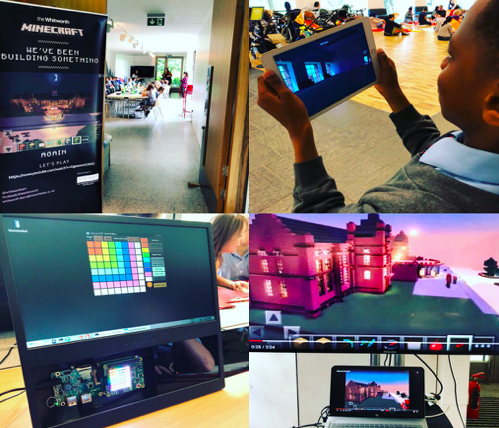
Since the beginning of 2017, the Whitworth Minecraft resource has been rebuilt by digital artist Gemma Potter using raspberry pi’s. This has made the resource non-dependent on wifi and internet connectivity allowing the resource to in any space around the Whitworth. The raspberry Pi’s provide mobility and access for workshop delivery and still functions as a running PC that’s compatible for coding and other ICT uses.
In June 2018, our Minecraft Masterclass for primary schools once again fully booked up quickly. It allowed us to explore future technologies with partner Digi Lab (a concept developed by the Library at the University of Manchester where space and support is provided to try, test and learn about new technologies) Using the Minecraft as stimuli, we exported the game back into iPads and enabled children to use the screens as viewfinders with a 360 photosphere Whitworth Minecraft image. Children navigated the digitally recreated gallery whilst being in the actual space. Other new technologies included programming with sense hats building a series of pixelated imagery to turn into animation.

Masterclass 2019
Our Minecraft resource played a pivotal part in this year’s Masterclass with the School of Mathematics. This week-long session explored reflections, rotations and symmetry within the collection and bought new, innovative ways of relating maths to arts. Children drew found patterns and then redeveloped them on grid paper developing pixel art in the process. This was then transferred over to a digital punch card reader connected to the Whitworth Minecraft. Patterncraft has been created by Gemma Potter as a tool for teaching fundamentals of programming and encoding date through the write once medium of punch cards. Since its creation, Gemma has been demoing this analogue to digital reader at the Whitworth and it has proved to be a powerful tool for engaging school children with all things binary.
The Patterncraft punch-card reader was used to convert 2D into 3D within the Minecraft game to colourful, vibrant and experiential results.
What next?
As in-game updates, mods and third-party content creators continue to be updated on Minecraft, the possibilities of future project work using this resource are endless. We are investing in kit that enables us to engage larger numbers of participants and exploring ways in which we can continue to animate our collections through the game mechanics. We would like to open up the resource to artists to interpret their own builds and structures in game to keep the resource fresh and relevant. Bookings for the workshop continue to grow each academic year and shows a healthy appetite for engagement across both KS1 and KS2 and future professional development courses for teachers will be devised as coding and ICT becomes more prevalent in schools.
If you are interested in this resource and raspberry pi’s coming to your school then email steven.roper@manchester.ac.uk
 Gathering of Strangers